How to Deal With Complex Social or Environmental Causes
Jan 28, 2026
If you’re trying to meaningfully engage with social or environmental causes today, chances are you feel overwhelmed. Not because you don’t care enough, but likely because everything seems connected to everything else.
Poverty links to education.
Education links to health.
Health links to climate.
Climate links to economics, politics, culture, history, and power.
These are often referred to as grand challenges: large-scale, persistent problems that cut across sectors, borders, and generations. They aren’t isolated issues but symptoms of deeper systemic patterns and structures.
Most people are never taught how to deal with this kind of complexity. We’re taught linear thinking: identify a problem, design a solution, implement it, control outcomes.
When applied to complex social or environmental causes, this approach often leads to frustration, hopelessness, burnout, or unintended consequences. And yet, the importance of acting has seldom been greater.
So how do we deal with the complexity of social or environmental causes - without freezing, oversimplifying, or burning out?
“Wicked Problems”: Why Social and Environmental Causes Are Uniquely Complex
Social and environmental causes are often described as wicked problems. Not because they’re morally bad, but because they don’t have simple solutions.
They tend to share several characteristics:
- No single, agreed-upon definition of the problem
- Multiple stakeholders with conflicting values and incentives
- Causes and effects that are non-linear and difficult to affect
- A symptom of another problem
- No clear endpoint where the problem is completely “solved”, only better
- Completely unique
Climate change is not just about emissions. Biodiversity loss is not just about conservation. And inequality is not just about income. Because these causes operate in multi-variable systems, they’re inherently complex.
Each issue is embedded in economic models, political structures, cultural narratives, and historical trajectories. Every ‘solution’ interacts with the system and reshapes it.
There are often unseen complex interdependencies and interactions. Trying to treat these challenges as if they were singular, independent problems often makes things worse.
Get a deeper understanding of systems thinking through our free online Systems Thinking 101 workshop! I share insights I’ve gained from leading workshops for cities and major organizations, raising millions in funding, and being a keynote speaker on systems change at conferences and lecture series.
Overwhelm, Decision Fatigue, and the Urgency for Action
Many changeworkers oscillate between two states:
- Overwhelm and paralysis because everything feels interconnected and impossible
- Urgent over-action because doing something feels better than doing nothing
Both are understandable responses. But neither is particularly effective.
Overwhelm often stems from trying to hold the entire system in your head at once. And feeling like you want to tackle everything. On the contrary, urgency without regular reflection often leads to working on symptoms rather than root causes.
There is a quieter, more sustainable path between these extremes. It begins with shifting your mindset.
Embrace Systems Thinking to See the Whole Picture
The term ‘systems thinking’ can in itself feel overwhelming, but I promise it’s pretty straightforward. Systems thinking doesn’t mean understanding everything in a single social or environmental cause. It means understanding how things relate and affect each other.
Instead of asking, “What is the problem and how do we fix it?”, systems thinkers ask:
- What patterns are producing this outcome?
- What structures enable these patterns?
- What assumptions or norms sit beneath those structures?
This mindset shift is subtle but profound. It moves us from fighting fires to redesigning the landscape that keeps creating them.
Importantly, systems thinking also invites humility. No single actor can control a complex system. This is why I use the term ‘changeworker’ instead of ‘changemaker’. No one can ‘make’ change, but we can all work towards it.
The Iceberg Model is my go-to when it comes to identifying the paradigms the current issue is based in and the paradigms you want to work towards. No matter the specific task at hand or project, hold this in your heart like a guiding north star.
Identify Leverage Points for Transformative Change
One of the most empowering ideas behind systems thinking is that: not all interventions are equal.
Some actions barely move the needle. Others shift the trajectory of the entire system.
These are known as leverage points - places within a system where a small change can lead to disproportionally large effects. Use the 5R Framework to find high-potential intervention points and then build a strategy to address whatever is deemed highest priority (of course adjusting the strategy as you try things and learn).
According to systems scholar Donella Meadows, the deepest leverage points often sit not at the level of events or policies, but at the level of:
- Flows of information
- Rules and incentives
- Power structures
- Goals of the system
- Underlying paradigms
This is why addressing root causes matters so much. It’s also why systems change work can feel incredibly slow, political, and uncomfortable.
Mapping the Ecosystem: Stakeholders, Actors, and Their Agendas
Before intervening, it helps greatly to map the ecosystem you are working within. Ecosystem mapping is often done as part of sensemaking process. Meaning, we’re processing information and attempting to make sense of it, so as to inform our future choices and actions.
This includes taking note of:
- Public institutions and regulators
- Private sector stakeholders
- Civil society organisations
- Relevant funders and investors
- Communities affected by the issue
- Informal power holders and cultural influencers
Each actor has different incentives, constraints, and perspectives. Some benefit from the status quo. Others bear its costs. And some aren’t so black and white, living somewhere in the middle.
Mapping these relationships helps you identify:
- Where resistance is likely to arise
- Where alliances are possible
- Where change could cascade through the system
- Where possible leverage points can exist
Crucially, this work is not meant to be done alone. A single person is understandably limited by their current knowledge, biases, and perspectives. Doing this exercise in a group makes things that may have been invisible or hard to see part of the collective domain and enables us to engage with these ideas in a new way. It can also help us to communicate our seeings and intentions, and situate our action in context with other actions and intervention points.
[Free PDF] Download my ecosystem mapping template
Want a guided how-to on ecosystem mapping? Watch our free online Ecosystem Mapping 101 workshop available now. You don’t have to go it alone.
Unpacking Root Causes, Historical Realities, and “Critical Complexification”
Many social and environmental causes are rooted in historical dynamics such as:
- Colonialism
- Extractive economic models
- Class hierarchies
- Patriarchal power structures
- Racialised systems of value and exclusion
Ignoring these key histories and realities leads to superficial solutions that are missing important context. Social and environmental causes are such complex, large entities because thousands of years have brought us here. Undoing the effects of thousands of years’ human decisions and actions is impossible without considering all of this. Acknowledging these factors adds complexity, yes, but also clarity - which is worth it!
This is sometimes called critical complexification: allowing the problem to become more complex so that responses can become more truthful.
For example, if you simply looked at the cause of ocean acidification as climate change, you’d be missing out on the full picture which would hurt your ability to think of truly feasible solutions.
Depth isn’t a luxury or a nice-to-have in systems change. The deeper you go, the better the changework.
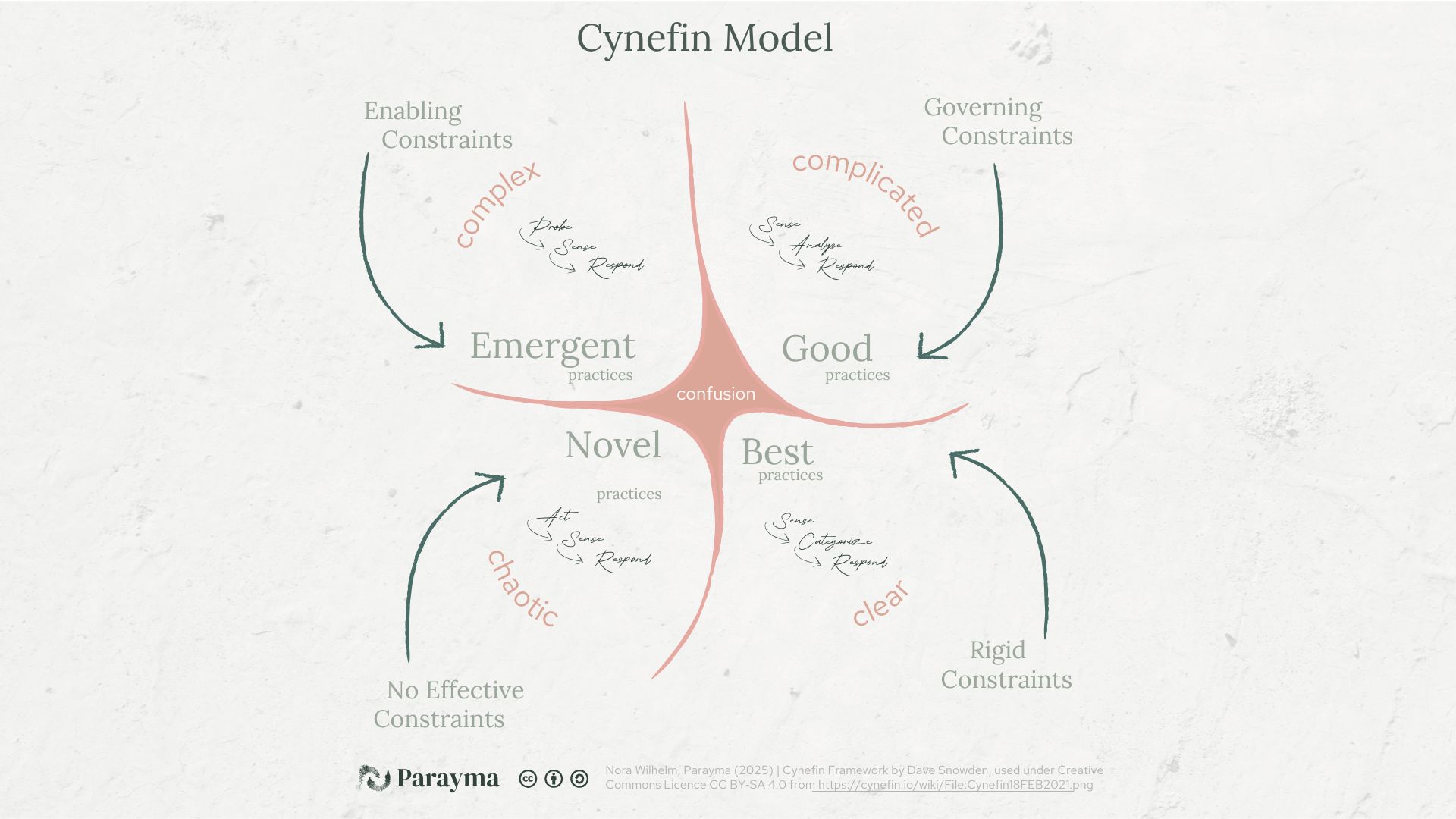
That said, don’t fall into the trap of trying to plan and control the complexity away. When a context is complex, we need to act in a way that benefits that complexity. I recommend using The Cynefin Framework to find ways that work with complexity, not against it.
Crafting Adaptive and Flexible Responses
In complex contexts, detailed long-term plans often fail or feel like pushing a boulder up a steep hill. Not because planning is useless, but because reality keeps changing.
Instead of rigid strategies, systems change calls for adaptive pathways:
- Clear, yet malleable, intention and direction
- Short feedback loops
- Willingness to adjust based on what emerges
- Continuous learning
- Open-mindedness
This approach values experimentation over perfection. It also reduces the pressure to “get it right” from the start.
Remember that if you keep your inner orientation towards paradigm shifts and embodying your values and vision, then you’re pulling on your thread and helping to “unravel the whole damn cloth”.
Defining Priorities and Measurable Outcomes
Working with complexity means intentionally choosing your focus. With so many variables, relationships, and actors, it can feel like you’re being pulled in a million directions. Trust me, I completely get that.
Helpful questions to ask yourself include:
- Where are we uniquely positioned to contribute? What are our unique strengths?
- What scale of action is manageable right now?
- What outcomes, however small, would signal meaningful progress?
You don’t need to work on everything. In fact, I don’t recommend even trying to! That’s a fast track path to overwhelm and burnout. Having experienced that myself in 2022, I can safely say that effective, sustainable changework happens when your focus feels realistically doable and energy-giving.
Finding your specific focus - the place where your skills, values, and energy intersect - is not selfish. It may feel limiting, but it’s necessary. And when everyone has their specific focus, most elements of a complex social and environmental are getting addressed. This is the beauty of changeworking in community, with others just as passionate as you.
Why Personal Alignment Matters So Much
When I was around 16 years old, I got my first guitar. I loved singing, and my absolute favourite song to sing was “What’s up” by the 4 Non Blondes. A classic, right?
I prepared for the showcase of the music school where I took guitar lessons, and I sang the song over and over. On the day of the concert, my teacher asked me if I wouldn’t mind having some of the other teachers join me - like a band. They would just lay a second guitar, drums and a bass on top of my electro-acoustic guitar and vocals. (I don’t remember the exact reason for this, but a vague memory or perhaps total fabrication is that the teachers usually also prepare something and didn’t manage this time).
This made me quite nervous, but I was like, ‘Why not?’. We had one brief rehearsal, and then we performed. It was a hit. Not just in the sense that my parents were proud, but it was really, really good - especially considering how spur-of-the-moment it was.
I never had a band, so I was overjoyed, and walking off stage, I genuinely felt like I could become a musician. It was so good in fact, that the teachers asked me to perform together again at the next showcase. This time, though, the song I had chosen for my own performance was less well-known, so they couldn’t just tag along and asked me instead to sing a song that “everybody knows”.
Their (last-minute, of course) suggestion was “All You Need is Love” by The Beatles. Now, in theory, this is a well-known song. You’d be hard-pressed to find anyone who doesn’t know how to sing along to the chorus. But could you sing the verse? Most likely not. It’s a talk-more-than-sing, kind of off-beat, type of verse that pretty much only true Beatles fans know. I didn’t.
We practised once, and I just couldn’t get the strange beat right. I felt truly uncomfortable, but once the whole thing was set in motion, I just didn’t know how to say no. So a couple of hours later, there I am, spotlight glaring in my face… The guitar starts, I feel the dread rising - and I miss the start.
In front of an audience that I guess was trying to look supportive, I fumble through the first verse. Everyone breathes a sigh of relief when I finally get to the chorus: “all you need is love PAPAPADADAAA all you need is love…” only to land right back where we started, with a second, awful verse… Until we’re back to the chorus “all together now! ALL YOU NEED IS LOVE”.
Let’s just say that I didn’t feel like I could be a musician when I walked off that stage. I never consciously decided to drop trying to form a band, but it would be years until I performed with one again.
Now, what’s the lesson here? There’s probably a bunch - I would be curious to hear what came to your mind first! Say no, follow your intuition, trust yourself over ‘experts’, etc.
But here’s what the lesson is to me, right now: the reason the first concert was amazing and the second one awful was because in the first one, it was *my* song. I felt it, I loved it, I would have probably done a decent job of it without a band, too.
They added an extra sparkle because they’re professional musicians and could easily just lay their art on top - but my art, my singing and guitar, was the foundation. In the second concert, I didn’t really know the song. I didn’t feel it. I would never have chosen it.
I tried to mould myself into something I was not, and forced myself to do something I was really uncomfortable about. If I had been able to both listen to my intuition and stand up for myself, I never would have ended up on that stage. Perhaps we would have changed the song, or not performed at all - both would have been better than the humiliating performance.
I did it because I thought I had to, because I was too afraid of disappointing the teachers. In doing so, I ended up disappointing not just them, but myself, and the audience, too.
Changework works in much the same way. If you follow what feels right and true to you, what’s calling your name, what’s on your mind and heart at all times of the day, then other people - experts, team members, collaborators - can lay their art (their changework) on top, and if they know their stuff as you do, it works. It harmonises. It creates a sum greater than its parts.
If you try to pursue a path or address a certain cause because you think you *have to*, out of a misplaced sense of obligation or shame, it won’t matter if the others are professionals or super talented. Your lack of alignment, your discomfort - it will permeate the whole song, the whole performance. No amount of effort, commitment or practice can truly make up for the fact that your heart is not in it. That you’re not up there singing from your soul.
Even if we had months and multiple rehearsals, our ‘All You Need is Love’ performance wouldn’t have become a hit like the first one was. Less embarrassing, certainly, but it still would have lacked that spark. This isn’t limited to the singers, either. If you’re a bass player (let’s say, an amazing ops person working within NGOs), it’s just as important to stay true to what matters most for you, what is your unique gift to bring - and this will call the right people to you, with skills and gifts complementary to yours.
Remembering this awkward moment on stage added another layer to my already deep conviction that when it comes to changework, pursuing what calls us is not selfish. Doing soul-aligned work is part of how we bring to the world what is uniquely ours to bring - and it’s with others doing the same that collectively, we might harmonise.
Collectively, we might shift paradigms. So I hope you’re not out there trying to play the violin when you’re meant to be hitting the drums, and, equally, not forcing yourself to play pop music when your heart beats for jazz. The world needs your very own song and gift.
Utilizing Decision Support Tools and Scientific Knowledge
Once your specific focus is established and feels good, tools can help make sense of any remaining complexity.
Useful approaches include:
- Causal loop diagrams
- Scenario planning
- Stakeholder research (surveys, in-person discussions, collating publicly available information)
- Collecting relevant data
Of course, these actions won’t eliminate uncertainty, but they’ll help you navigate it better.
Equally important is knowing when not to overanalyse. In complex systems, action and learning must happen together. Try not to get bogged down by the intricacies and details. Sometimes doing that can feel overwhelming and paralysing, which we don’t want!
Fostering Multi-Stakeholder Platforms and Public Engagement Mechanisms
Effective responses to complex causes often involve:
- Cross-sector coalitions
- Community-led processes
- Participatory governance
- Transparent dialogue spaces
These platforms allow diverse knowledge to surface. They also distribute ownership of both problems and solutions.
While slower than top-down decision-making, the outcomes of these discussions tend to be more resilient.
Through my many years of changework, I deeply believe that the best work happens in solidarity and community - with open conversations that take into account all stakeholders, not just those with traditional forms of power.
These solutions consider everyone involved, which reduces harm and increases justice for everyone. So this is a key consideration when dealing with the complexitiy of social and environmental causes.
Translating Strategy into Action: Bridging the Knowing-Doing Gap
Many changeworkers understand what needs to change. This may even be you right now! The challenge lies in doing it. If you’re feeling tension, uncertainty, anxiety, or confusion, it’s a great time for you to focus on bridging the knowing-doing gap. Scientific studies show that knowing about complex societal issues and not doing anything about them often leads to feeling a sharp lack of control and intense hopelessness.
Bridging the knowing-doing gap involves:
- Starting at a manageable scale
- Acting before everything is clear
- Learning and adapting from early signals
- Staying connected to deeper purpose
- Connecting to communities already taking action
For example, you might start by organizing a small neighborhood fundraiser, calling your elected official’s office to voice your thoughts, or by volunteering with a local NGO you like.
Action builds confidence. Confidence builds energy, focus, and capacity.
Navigating this terrain and want grounded support? Watch our free online Systems Change 101 workshop to get an even better understanding of how to best deal with the complexity of social and environmental causes. You don’t have to go it alone.
Finding Supportive Resources
As someone who’s raised millions in funding for changework, I personally deeply know how important funding and resources can be to deal with the complexity of social and environmental causes. They make changework happen faster and easier.
This may include:
- Grants for changeworkers
- Political capital
- Networking (in-person or on LinkedIn)
- People’s time and attention (e.g. social media or local bulletin boards)
- Accreditations or certifications
Especially if you want to start your own NGO or become a social entrepreneur, all of these resources are gold for you.
Of course, obtaining funding and other resources isn’t easy. It often means telling better stories about why systems change matters in order to get buy-in. Check out the book Made to Stick by Chip and Dan Heath to learn more about persuasive storytelling.
Learning, Adaptation, & Resilience
Continuously learning, adapting, and staying resilient are crucial to navigating complex social and environmental causes. Complex systems never stand still, so neither can our responses.
Sustained impact depends on:
- Continuous reflection
- Willingness to adapt
- Open-mindedness and flexibility
- Capacity to rest and regenerate (this one’s so important!)
Unfortunately, burnout is common amongst activists and changeworkers. We tend to take a lot onto our shoulers, motivated by our passion for the cause. But if you stay stuck in how you started, you won’t progress sustainably or meaningfully.
I can’t tell you how many times I’ve seen organizers and leaders burn out. Including myself back in 2022. And not only are you totally unable to keep working, but it takes months to recover. So if you haven’t been prioritising adaptating based on new information and building resilience, I recommend starting now! It’s never too late.
Changeworkers can build resilience by:
- Staying aligned with their values
- Defining and enforcing boundaries
- Sharing the load
- Remembering that no one enacts meaningful systems change alone
- Scheduling regular rest and nourishing activities
Even if it feels difficult, it’s better to start now than to never start and end up burned out in a couple of years, I promise.
Empowering Action in a Complex World
Learning how to deal with the complexity of social or environmental causes is not about mastering everything. It’s mainly about finding your best-fit place within the whole.
Honouring complexity without becoming paralysed by it.
Choosing a specific focus without losing sight of interconnectedness.
Acting with self-compassion, courage, and care for others.
Now Enrolling
Changework Compass
The programme that helps you name your unique contribution - and build the confidence, clarity, and skills to bring it, without burning out in the process or doing it all alone.
Book your spot today in the Fall Cohort. 35 spots only.
Starting on September 14th. We’d love to have you with us!
Subscribe to The Changework Journal
Get first access to new offers, free or discounted tickets to events Nora speaks at, exclusive access to funding opportunities we source from our network (not shared anywhere else on our channels), and more!