15 Smart Social Entrepreneurship Ideas You Can Start Today
Oct 21, 2026
Have you ever looked at a social or environmental challenge and thought surely there must be a better way of doing things?
Perhaps you're worried about climate change, inequality, access to education, or the way our economy treats people and nature. You want to contribute to a better future, and you're wondering whether starting a social enterprise could be your way of doing so.
The good news is that there are countless social entrepreneurship ideas worth exploring, from community-owned renewable energy projects to circular fashion businesses and inclusive employment initiatives.
At Parayma, we believe that good social entrepreneurship is a powerful pathway towards a more just and regenerative future. And we also know that the most meaningful initiatives often begin with something quite simple: a person who cares enough to question the status quo and explore what might be possible instead.
Whether you're an aspiring social entrepreneur, an experienced changeworker, or simply curious about turning your desire to make a difference into meaningful action, there's something here for you.
How is social entrepreneurship different from traditional entrepreneurship?
Traditional entrepreneurship generally focuses on identifying opportunities, creating products or services, and developing financially viable businesses. Social entrepreneurship applies many of these same principles while making social or environmental impact central to the organisation's purpose.
Consider two clothing businesses.
One might focus primarily on producing fashionable garments, attracting customers, and generating profits for its owners or investors.
Another might develop clothing made from discarded textiles, employ people who have been excluded from the labour market, and advocate for more responsible production practices throughout the fashion industry.
Both need customers, resources, and a viable business model. Both have their own pros and cons. Their underlying purposes and definitions of success, however, are quite different.
For a social enterprise, success could include financial sustainability alongside outcomes such as improved livelihoods, reduced environmental harm, stronger communities, or changes in industry practices.
Some social enterprises generate revenue through selling products or services, while others combine earned income with grants, donations, public funding, or partnerships.
The specific organisational structure can vary, too. Social entrepreneurship can take place through a nonprofit organisation, a cooperative, a purpose-driven business, or a hybrid model.
What connects these approaches is their intention to create meaningful social or environmental value.
These ambitions also introduce important questions about how decisions are made, who benefits, and how the organisation remains accountable to its mission.
A business selling eco-friendly products, for example, might still rely on exploitative working conditions or unsustainable growth expectations. Looking at the entire business model helps reveal whether its practices align with the future it hopes to create. This is so important!
Why systems thinking matters when developing social enterprise ideas
Here's something we encourage changeworkers to consider early in their journey: the challenges we care about are usually connected to much larger systems.
Take plastic pollution as an example.
You might develop a social enterprise that collects discarded plastic and transforms it into useful products. This could reduce waste, create employment, and raise awareness about responsible consumption.
Yet plastic pollution is also influenced by production practices, consumer norms and expectations, regulations, corporate incentives, infrastructure, and the underlying assumptions of our economic system.
A social enterprise that wants to contribute to lasting transformation might therefore explore opportunities to influence several of these factors.
It could collaborate with manufacturers to redesign packaging, work with municipalities to improve reuse infrastructure, or support policy changes that encourage businesses to reduce unnecessary plastic production.
This is where systems thinking becomes particularly valuable!
Systems thinking invites us to explore how different elements of a social or environmental challenge interact with each other and which changes might influence the wider system.
One helpful tool I highly recommend is the Iceberg Model, which encourages us to look beneath visible events towards recurring patterns, structures, and underlying beliefs.
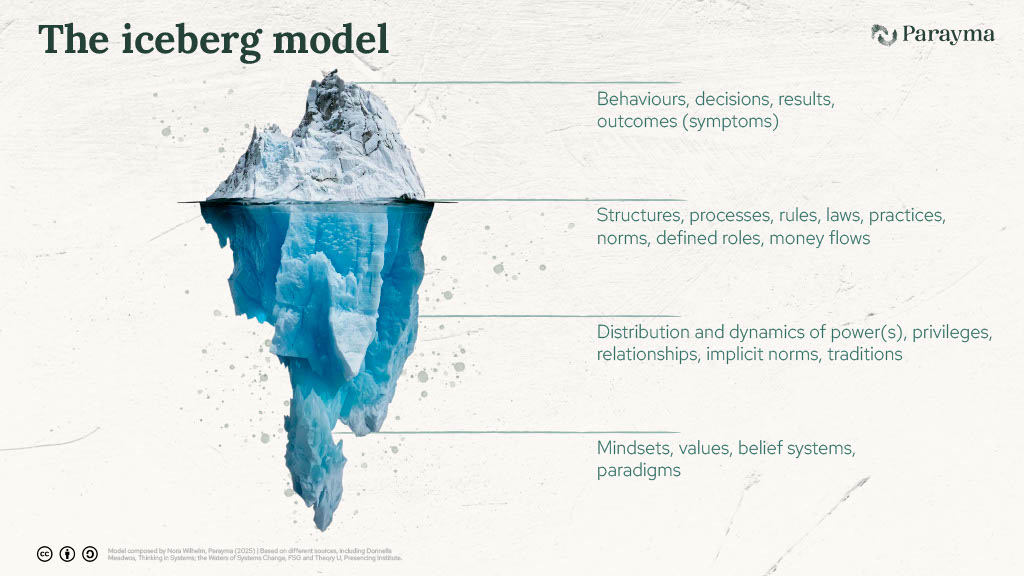
For aspiring social entrepreneurs like yourself, this perspective can open up really exciting possibilities.
Rather than choosing an idea solely because it sounds innovative, you can begin exploring where your particular contribution might have the greatest potential.
This is exactly what we help with in Changework Compass! We guide aspiring social entrepreneurs and changeworkers to feel confident about their pursuits. Consider joining us and be amazed at what you accomplish in the next 6 months.
You might discover that a new product is needed. Or perhaps the greatest opportunity lies in changing an existing service, creating a collaborative platform, influencing institutional practices, or helping communities gain more ownership over essential resources.
There are many possible pathways.
Can a small social enterprise really contribute to systems change?
Absolutely. Although the scale and nature of its contribution will depend on the context.
Small initiatives can introduce new ways of working, demonstrate alternatives to established practices, and build relationships that support wider transformation.
Let’s imagine a community-owned food cooperative that begins by connecting local farmers with neighbourhood residents.
Initially, its impact might include providing fresh produce, supporting local livelihoods, and strengthening relationships between producers and consumers.
Over time, it might influence local procurement policies, encourage schools to purchase food from regenerative farms, or inspire neighbouring communities to develop similar models.
Its contribution can grow through collaboration and changes in how the wider food system operates.
Of course, this requires patience, reflection, and a willingness to adapt.
Systems change is rarely linear, and meaningful outcomes often emerge through the combined efforts of many different actors.
You can start by asking yourself three questions:
- Which social or environmental challenge do I feel particularly drawn to?
- What might be contributing to this challenge beneath the surface?
- Where could my specific strengths, experiences, relationships, and resources make a useful contribution?
Keep these questions in mind as you explore the following ideas. Why? You may find yourself inspired by an approach you hadn't previously considered.
15 Social Entrepreneurship Ideas for Social and Environmental Impact
If you're searching for social entrepreneurship business ideas, you might be surprised by just how many different forms a social enterprise can take.
Some ideas involve developing innovative products, while others focus on delivering services, creating employment opportunities, building community infrastructure, or changing how resources are distributed.
The following ideas offer starting points across sustainability, education, social justice, health, and community development.
Each includes a possible business model and an opportunity to think more systemically about the change you want to contribute to.
1. Create a circular fashion and textile enterprise
The fashion industry presents a world of opportunities for social entrepreneurs interested in waste reduction, fair working conditions, and more regenerative production systems.
You could create a business that repairs clothing, transforms discarded textiles into new products, or helps fashion brands develop circular supply chains.
Possible revenue streams: Clothing sales, repair services, subscriptions, workshops, or partnerships with fashion retailers.
Systems change opportunity: Collaborate with manufacturers, policymakers, and consumers to encourage longer-lasting clothing, fairer labour practices, and more responsible production.
A manageable first step: Speak with local textile collectors, repair specialists, and potential customers in your community to understand which materials and services are currently overlooked.
2. Develop a community-owned renewable energy cooperative
Access to affordable, renewable energy is an important consideration for communities seeking greater resilience and environmental sustainability.
Where it may be too expensive for most families to install, a community energy cooperative could enable residents to collectively invest in solar panels or other renewable energy infrastructure.
Possible revenue streams: Electricity sales, member contributions, energy services, and eligible public incentives.
Systems change opportunity: Help shift energy ownership towards communities, strengthen local participation in energy decisions, and support more equitable access to renewable energy.
A manageable first step: Explore existing community energy cooperatives and speak with local energy organisations about regulations, financing, and opportunities for collaboration.
3. Start a regenerative agriculture or community food enterprise
Food systems connect environmental health, livelihoods, biodiversity, public health, and social inequality.
You could develop a community-supported agriculture initiative, connect regenerative farmers with local buyers, or create a surplus food distribution enterprise like FoodCloud did in Ireland.
Possible revenue streams: Produce subscriptions, wholesale partnerships, educational programmes, and institutional procurement contracts.
Systems change opportunity: Strengthen local food systems, support regenerative farming practices, and influence how schools, businesses, and public institutions purchase food.
A manageable first step: Meet with local growers and community organisations to identify unmet needs before deciding which business model to explore.
4. Build an inclusive employment and skills-training enterprise
Many people experience barriers to employment because of discrimination, disability, displacement, limited access to education, or other structural inequalities.
A social enterprise could provide meaningful employment, vocational training, or pathways into industries where opportunities have traditionally been limited.
For example, you might create a catering company employing refugees, a digital agency supporting young people entering the workforce, or a local grocery cooperative owned by workers from underrepresented communities.
Possible revenue streams: Product and service sales, employer partnerships, training contracts, and grants.
Systems change opportunity: Advocate for inclusive recruitment, fair wages, accessible workplaces, and recognition of skills gained through nontraditional pathways.
A manageable first step: Listen to people experiencing employment barriers and explore which existing organisations are already supporting them.
5. Launch an affordable education or digital learning platform
Educational inequality affects people's opportunities throughout their lives.
You could develop accessible learning resources, mentorship programmes, digital literacy workshops, or alternative education models for communities with limited access to existing opportunities.
Possible revenue streams: Institutional subscriptions, training contracts, memberships, and cross-subsidised educational programmes.
Systems change opportunity: Influence how educational institutions recognise different forms of knowledge, distribute learning resources, and support people who have been excluded from traditional pathways.
A manageable first step: Identify a specific learning barrier and work with potential participants to understand what would genuinely improve their experience.
6. Create a repair café or community reuse hub
A repair café brings people together to repair household items, clothing, bicycles, or electronics.
This idea combines environmental sustainability with practical skills development and community connection.
You could begin with occasional repair events and gradually develop a financially sustainable enterprise offering workshops, repairs, and shared access to equipment.
Possible revenue streams: Repair fees, memberships, educational workshops, and partnerships with local businesses.
Systems change opportunity: Help normalise repair, advocate for the right to repair, and encourage manufacturers to design products that last longer.
A manageable first step: Organise a small repair gathering with experienced volunteers or local professionals and observe which services people need most.
7. Develop accessible mental health and wellbeing services
Access to mental health support unfortunately remains unequal across many communities.
A social enterprise could provide affordable wellbeing programmes, peer-support initiatives, workplace wellbeing education, or community-based services.
Depending on the approach, some activities may require qualified mental health professionals, appropriate safeguarding, and regulatory compliance.
Possible revenue streams: Workshops, organisational contracts, memberships, grants, and sliding-scale service fees.
Systems change opportunity: Influence workplace cultures, improve access to support, and encourage institutions to address structural contributors to stress and poor wellbeing.
A manageable first step: Identify a particular community and collaborate with qualified practitioners to understand its needs and the support already available.
8. Start an ethical technology or digital inclusion enterprise
Technology shapes access to information, employment, education, financial services, and civic participation.
You could create an enterprise that refurbishes devices, provides affordable internet access, teaches digital skills, or develops accessible digital tools.
Possible revenue streams: Refurbished device sales, technical support, training contracts, and institutional partnerships.
Systems change opportunity: Promote digital accessibility, responsible technology design, and more equitable access to digital infrastructure.
A manageable first step: Speak with community organisations to understand which digital barriers are most significant and whether existing solutions could be improved.
9. Build a community housing or cooperative living initiative
Housing affordability and insecurity are connected to land ownership, financial systems, public policy, and urban development.
A social enterprise could explore cooperative housing, community land trusts, shared living arrangements, or services that support more affordable and sustainable housing.
Possible revenue streams: Membership contributions, rental income, development partnerships, and eligible public funding.
Systems change opportunity: Support alternative ownership models, community participation in housing decisions, and policies that protect long-term affordability.
A manageable first step: Research established housing cooperatives and community land trusts before exploring the legal and financial requirements in your area.
10. Create a sustainable mobility or transport enterprise
Transport affects access to employment, education, healthcare, and community life.
A social enterprise could offer affordable bicycle-sharing services, accessible transport, cargo-bike deliveries, or mobility solutions for underserved communities like the elderly.
Possible revenue streams: Memberships, transport fees, business partnerships, and public service contracts.
Systems change opportunity: Encourage cities to prioritise accessible public transport, cycling infrastructure, and lower-emission mobility systems.
A manageable first step: Map transport barriers in a particular neighbourhood and speak with residents about their daily experiences.
11. Develop a social enterprise supporting older adults
Ageing populations create opportunities to rethink how communities support older people.
You could develop intergenerational learning programmes, accessible technology services, community activities, or practical support that helps older adults remain connected and independent.
Possible revenue streams: Service fees, memberships, institutional contracts, and community partnerships.
Systems change opportunity: Challenge age-related exclusion and influence how communities design housing, transport, technology, and public spaces.
A manageable first step: Invite older adults into the design process and ask which changes would make the greatest difference to their lives.
12. Launch a community-owned platform cooperative
Many digital platforms rely on business models where ownership and decision-making are highly concentrated among investors.
A platform cooperative offers an alternative in which workers, users, or community members share ownership and governance.
You could create a cooperative marketplace for local producers, a worker-owned delivery platform, or a digital service connecting independent professionals.
Possible revenue streams: Transaction fees, subscriptions, membership contributions, and service contracts.
Systems change opportunity: Demonstrate more democratic business ownership and fairer distribution of economic value.
A manageable first step: Find a small group of potential members who share a specific need and explore whether cooperative ownership would serve them.
13. Create a social procurement and ethical supply-chain consultancy
Organisations make purchasing decisions that influence working conditions, environmental outcomes, and local economies.
A social enterprise could help businesses and institutions purchase goods and services from ethical suppliers, social enterprises, and community-owned organisations.
You could take trainings to educate yourself on this topic, or potentially hire or source volunteer professionals to offer their services.
Possible revenue streams: Consulting fees, supplier assessments, training, and long-term procurement partnerships.
Systems change opportunity: Influence procurement policies and redirect purchasing power towards organisations creating positive social and environmental value.
A manageable first step: Choose one sector, such as food, textiles, or construction, and investigate the barriers organisations face when trying to source responsibly.
14. Develop a nature restoration and biodiversity enterprise
Healthy ecosystems support biodiversity, climate resilience, water quality, and human wellbeing.
You could create an enterprise restoring degraded landscapes, supporting urban biodiversity, planting or growing native plants, or helping organisations improve ecological practices.
Possible revenue streams: Restoration contracts, plant sales, educational programmes, and partnerships with landowners or public institutions.
Systems change opportunity: Encourage regenerative land management, stronger biodiversity protections, and recognition of the interconnectedness between human and ecological wellbeing.
A manageable first step: Connect with local ecologists, conservation groups, and land stewards to understand which restoration activities are genuinely needed.
15. Start a systems change facilitation or social innovation enterprise
Perhaps your strengths lie in connecting people, facilitating conversations, and helping organisations navigate complex challenges.
You could create a social enterprise that supports collaborative innovation, facilitates multi-stakeholder processes, or helps organisations develop systems-informed strategies.
For example, you might bring together local government, businesses, community organisations, and residents to explore more regenerative approaches to food, housing, or transport.
Possible revenue streams: Facilitation contracts, training programmes, consulting services, certification programmes, and collaborative project funding.
Systems change opportunity: Strengthen relationships between stakeholders, improve collective decision-making, and support coordinated action on complex challenges.
A manageable first step: Join an existing collaborative initiative to develop your facilitation skills and better understand how systems change processes unfold in practice.
Which social entrepreneurship ideas are most promising?
The potential of any social entrepreneurship idea depends entirely on the context, the needs of the people involved, the resources available, the wider systems it seeks to influence, and your unique abilities and skills.
A repair café might create meaningful local impact with relatively modest resources. A community energy cooperative could transform how a neighbourhood produces and owns energy, but may require substantial capital and regulatory expertise.
Similarly, a digital education platform could reach many people, yet its impact will depend on accessibility, educational quality, and whether it addresses the barriers learners actually experience.
As you explore these possibilities, consider three dimensions:
- Social and environmental value: What positive outcomes could the enterprise contribute to, and for whom?
- Financial viability: Who would pay for its products or services, and could that income realistically sustain the work?
- Systems change potential: Could the initiative influence wider practices, relationships, policies, or underlying assumptions?
It's also worth considering your own relationship with the work.
Which ideas genuinely interest you? Where do you already have useful skills, relationships, or experience? And what kind of work would allow you to contribute meaningfully while maintaining your own wellbeing?
You may find that several ideas appeal to you for different reasons.
That's perfectly fine.
Exploration is part of developing clarity, and the next section will help you begin identifying which direction might be right for you.
Feeling inspired, but unsure which idea is yours to pursue?
At Parayma, we've created the Changework Compass to specifically help people who care deeply about the world identify their unique (and most impactful) contribution towards a more just and regenerative future.
Through our SEED framework - Self-awareness, Envisioning, Ecosystem-Awareness, and Designing - you'll explore your strengths, clarify the future you want to contribute to, understand the systems you hope to influence, and develop a practical direction for your changework.
How to Choose and Develop a Social Entrepreneurship Idea That Aligns With Your Purpose
Finding the right social entrepreneurship idea begins with understanding yourself, the change you hope to contribute to, and the wider context in which you want to work.
You may already have several ideas, or perhaps you're feeling drawn towards a particular cause without knowing what your contribution could look like.
Both are valuable starting points.
Based on my several years of being and working with changeworkers, I encourage aspiring social entrepreneurs to approach this process with curiosity, self-awareness, and an openness to possibilities they might not have considered yet.
1. Begin with your values, strengths, and sense of purpose
Before choosing a business idea, take some time to reflect on what matters to you.
Which injustices or environmental challenges move you most deeply? What kind of future would you love to help create?
Your answers can reveal important clues about the direction you want to explore.
Consider your existing strengths, too.
Perhaps you're a skilled communicator who can bring people together. Maybe you're particularly good at analysing complex information, creating practical solutions, or helping others learn.
These abilities can become valuable contributions to social entrepreneurship.
You might find it helpful to write down:
- Three social or environmental issues you care about.
- Three strengths or skills you enjoy using.
- Three experiences that have shaped your understanding of the world.
- Three activities that leave you feeling energised and fulfilled.
Look for connections between your answers.
Remember that your purpose can evolve as you learn, grow, and encounter new opportunities.
You have permission to explore. In fact, I highly encourage you to explore what you feel drawn to (and why!) even if it’s surprising.
2. Understand the challenge before designing your solution
One common mistake in social entrepreneurship is becoming attached to an idea before fully understanding the challenge it aims to address.
Imagine wanting to improve access to education in an underserved community.
You might immediately think about developing an online learning platform.
Yet conversations with learners could reveal that unreliable internet access, financial pressures, language barriers, or limited time are more significant obstacles than the availability of educational content.
Understanding these realities might lead you towards a very different solution.
Start by speaking with people who experience the challenge directly, as well as organisations already working in the field.
Listen carefully, question your assumptions, and remain open to discovering that your original idea needs to change.
You can also explore the underlying structures that influence the challenge, including policies, incentives, resource distribution, and cultural norms.
This will help you identify opportunities for a more meaningful contribution.
3. Explore the ecosystem and find potential collaborators
Social entrepreneurship takes place within an ecosystem of people, organisations, institutions, and relationships.
Really fully understanding this ecosystem can help you identify existing initiatives, potential collaborators, and opportunities for change.
For example, if you're interested in developing a regenerative food enterprise, your ecosystem might include farmers, retailers, consumers, policymakers, schools, investors, and community organisations.
Each influences how the food system operates.
An ecosystem map can help you visualise these relationships and identify where collaboration could make a difference.
Ask yourself:
- Who is already working on this challenge?
- Which organisations share similar aspirations?
- Whose perspectives are missing from important decisions?
- Where are resources concentrated?
- Which relationships could support meaningful change?
You might discover that joining or strengthening an existing initiative would be more valuable than establishing a new organisation.
And if you do decide to start something, you'll have a much clearer understanding of where your enterprise fits.
4. Test your social enterprise idea on a manageable scale
Once you've identified a promising direction, begin exploring how it might work in practice.
You could organise a small workshop, develop a prototype, offer a pilot service, or collaborate with an existing organisation.
The aim is to learn from real experiences before committing substantial resources.
Suppose you're considering a circular fashion enterprise.
You might begin by organising a clothing repair event, interviewing potential customers, or testing whether local businesses would pay for textile collection services.
Pay attention to what people value, what challenges emerge, and whether your proposed approach is financially realistic.
Try to identify a few indicators that can help you understand both financial viability and social or environmental outcomes.
For example, you might measure customer demand, operating costs, materials diverted from waste, and participant satisfaction.
As you gather feedback, allow your idea to evolve.
A willingness to learn and adapt is one of your greatest assets as a social entrepreneur.
5. Design a financially sustainable business model
Even the most inspiring social entrepreneurship ideas need financial resources to become reality.
Financial sustainability matters because it allows you to continue your work, compensate people fairly, and invest in your mission over time.
Explore who might be willing and able to pay for your product or service.
Depending on your idea, this could include individual customers, businesses, public institutions, or partner organisations.
You might also combine different funding sources.
For example, an inclusive employment enterprise could generate income through commercial contracts while receiving grants for additional training or support services.
Be realistic about your costs, including your own compensation.
Social entrepreneurs sometimes feel pressure to sacrifice their financial security because they care deeply about their cause.
Yet creating a regenerative future also means considering how we sustain ourselves and the people working alongside us. This is extremely important!
If you’re working around the clock and not getting adequately paid for it (within a reasonable timeframe from starting up), your work will be hurt.
Before getting started, prioritize how you’ll be able to fund your living expenses and invest in your future.
6. Make space for inner development alongside outer action
Social entrepreneurship can be deeply meaningful, and it can also involve uncertainty, resistance, and considerable responsibility.
You might encounter financial challenges, conflicting stakeholder expectations, or periods when progress feels frustratingly slow.
Developing self-awareness, emotional resilience, and supportive relationships can help you navigate these experiences.
Take time to notice how you respond to uncertainty and setbacks.
Are you placing unrealistic expectations on yourself? Do you feel responsible for solving challenges that require collective action?
Learning to recognise these patterns can help you develop healthier ways of working.
Seek out peers, mentors, and collaborators who understand the realities of changework.
And remember to make space for activities and relationships that nourish you beyond your professional mission.
I strongly believe that inner and outer transformation are deeply interconnected. The way we approach ourselves, our relationships, and our work influences the future we help create.
7. Choose one meaningful next step
By now, you might have discovered an idea that genuinely excites you.
Or perhaps you've realised that you need more time to explore your purpose, understand a particular challenge, or connect with people already working towards change.
Either way, you can begin moving forward. It may feel scary, but if you really want to do it then that fear is simply your brain wanting to keep you comfortable.
Choose one small action that feels achievable within your current circumstances.
That might involve reaching out to a social entrepreneur you admire, attending a community event, researching a cooperative business model, starting to post on social media to start building a personal brand, or having a conversation with someone affected by the issue you care about.
Give yourself an opportunity to learn from that action before deciding what comes next.
You can build confidence through experience, strengthen your understanding through relationships, and refine your direction as new insights emerge.
Your contribution may eventually take the form of a social enterprise! It might also lead you towards a collaborative initiative, an existing organisation, or an entirely different role within a wider movement for change.
What matters is finding a pathway that allows you to bring your strengths and values into meaningful action.
Your social entrepreneurship journey starts with finding your unique contribution.
There is tremendous potential within social entrepreneurship to create more just, inclusive, and regenerative ways of living and working.
The ideas we've explored offer a glimpse of what becomes possible when people combine entrepreneurial creativity with a commitment to social and environmental wellbeing.
And there are many more possibilities waiting to be discovered - that’s the exciting part!
As you consider your next steps, I invite you to remain curious about the wider systems you want to influence, the people you might collaborate with, and the unique contribution you can bring.
You can care deeply about the world while also caring for yourself.
You can pursue ambitious change while acknowledging that meaningful transformation takes time and collective effort.
And you can begin exploring your path even when you don't have every answer.
If you're ready to gain greater clarity about your purpose and develop a realistic, grounded direction for your changework, we'd love to support you.
Changework Compass brings together self-reflection, systems thinking, actionable tools, and opportunities for connection to help you discover where your contribution matters most.
Because a more just and regenerative future needs people who are willing to imagine new possibilities - and begin bringing them to life. You got this!
Seed, Root, Bloom, or Harvest?
Take the Quiz!
A short reflective quiz to find your season of changework.
Subscribe to The Changework Journal
Get first access to new offers, free or discounted tickets to events Nora speaks at, exclusive access to funding opportunities we source from our network (not shared anywhere else on our channels), and more!