On Choosing: What Gets Lost When We Stop Believing in Public Schools
Aug 07, 2026
My grandmother was married at fourteen. She grew up in a village in the hills of Uttarakhand, and like most girls of her generation, the question of what she would become was never really a question. The path was already laid- marriage, household, children, service to family. Education was not something that belonged to her. Not because she wasn't capable of it. Because no one had yet fought hard enough to make it possible.
That fight was happening, though. In the same hills, in the same decade, a group of women were organising- quietly, persistently, for something that should not have needed fighting for: the right of girls to go to school. Sudesha Devi was one of them, one of the leaders of the Chipko movement. She and her companions understood that protecting forests and educating girls were not separate struggles- both were about who gets to have a future, and on whose terms.
My grandmother did not benefit from that struggle. But my mother did.
What I grew up watching
My parents became teachers almost by accident. My father took the job because it was available and carried it across countries, teaching in private schools in India, Botswana, and Oman. My mother became a teacher because that is what women did. And yet what I saw growing up beside them was that their job was not an obligation to them. My father started his day with extra classes with his students and ended it the same way. I have seen him meet students from twenty-five years ago and witnessed the warmth between them, the kind of mutual care that does not fade. My mother conducted classes after school, kept learning how to teach better, quietly and without fanfare. They gave everything to their students and taught me how love and care can expand the boundaries of one’s biological family.
I grew up watching what a teacher could be, in schools with sufficient resources and schools with a scarcity of resources. I work now in schools with limited resources. The schools changed. The countries changed. But something stayed constant: the question of who gets to learn and under what conditions. I was watching it from many angles before I understood what I was seeing. That gap was the first thing that felt like injustice. It has not yet stopped feeling that way.
Between worlds
I grew up between worlds.
Born near the Ganga river, I spent my childhood moving- Rishikesh, Dehradun, my village, villages where my mother would be posted, and stretches of time in Botswana and Oman. The time in villages gave me independence, joy and friendship, but also an early and uncomfortable awareness: the lives lived by the girls around me and the life I was living were not the same. That gap- quiet, persistent, never quite left me. What the movement between worlds gave me was a question I couldn't shake: What does it take for a person to live fully? Not productively. Not successfully. Fully. And alongside it a quieter, more uncomfortable one: What do I do with what I've been given? I was the first in my family to have certain freedoms- to think, to choose, to experiment, to raise questions. That felt less like privilege and more like responsibility.
A responsibility I had not yet learned to name but that had been accumulating across generations.
The first real choice
That question waited. It sharpened. And then it offered me a door. College was when the first intentional choice arrived.
The path was clear: Commerce degree, Chartered Accountant exams, a stable career. I was on it. And then parallely I started volunteering. With children in spaces that had nothing to do with balance sheets. And something shifted. It was daunting at first, lonely in the way that choosing something unfamiliar always is. I remember doubting myself- am I doing this right? Am I letting people down? But I also remember the moment that doubt gave way to something else: investment. Deep, surprising, total investment. I wasn't following someone else's map of the world anymore. I was watching, doing, learning and building my own.
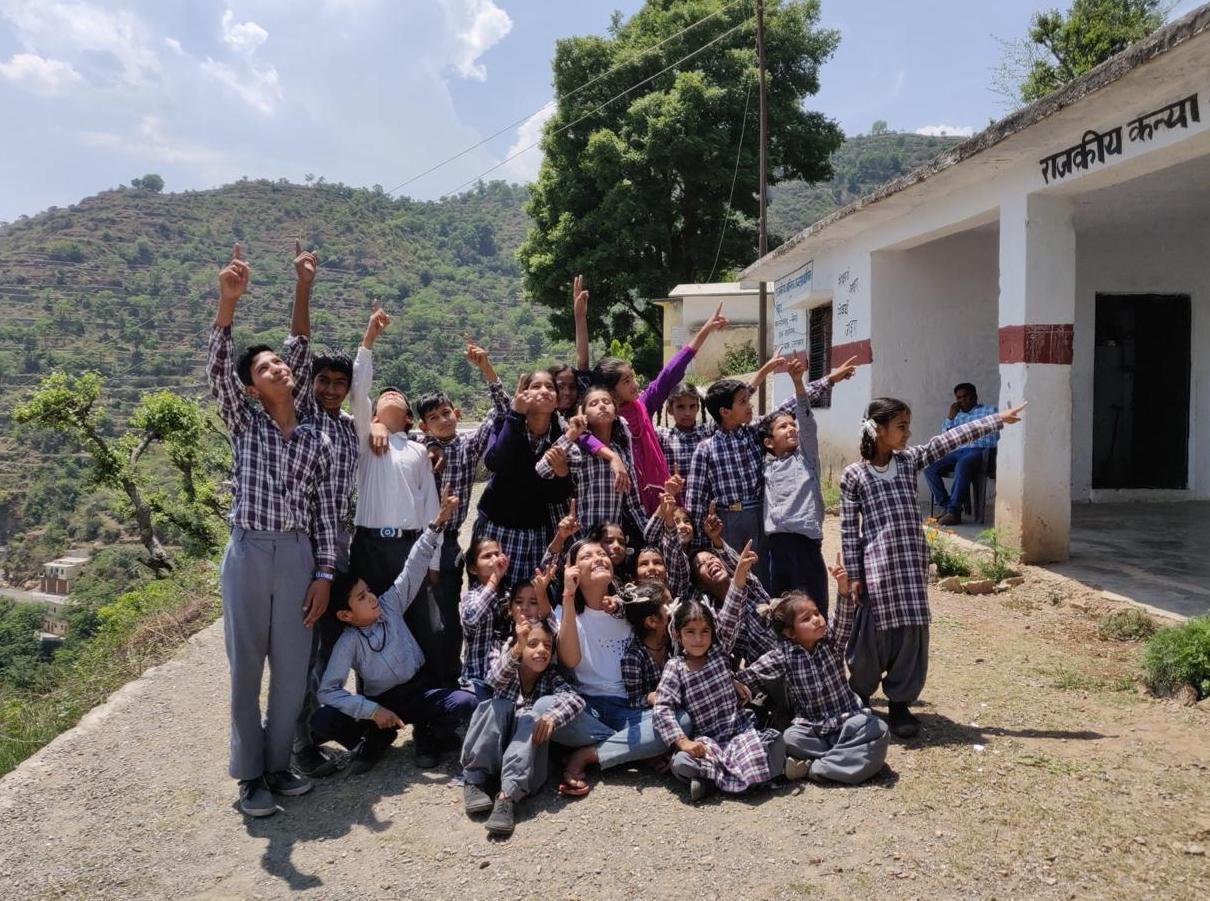
Volunteering in a rural, hilly school during college
Volunteering gave me proximity. The real shift came when I started observing and asking about one specific child in front of me.
Who would I choose to be for her?
The second choice didn't arrive as a decision. It arrived as a girl in a Grade 4 classroom.
The whole class would complain about her. She would break into anger mid-lesson, argue, and disrupt. I remember feeling helpless and slowly choosing to replace that helplessness with curiosity. I started sitting with her outside class, asked what she liked and what she didn't. She took time to open up. Eventually, I asked if I could visit her home.
What I found there reframed everything. She was the eldest sibling, carrying caregiving responsibilities most adults would find heavy. And the narrative she heard at home, repeated and consistent, was that she was not capable of doing, of achieving, of becoming anything much.
I went back to school and asked myself two questions I have not stopped asking since: who do I want to be with her? Who can I be for her?
That was my first intentional recognition of the power a teacher holds.
Slowly, things shifted. There was a meeting at school- parents were invited, children were presenting. She walked to the front of the class and shared a story. The room broke into applause when she finished. Her mother was in the audience, with tears in her eyes. She said she was proud of her daughter.
I have carried that moment for years. She taught me to trust, to stay curious, and to never give up on a child. And she taught me something about power- that it is not neutral, that it is always doing something, and that the question is only ever what you choose to do with it.
This incident deepened my belief in the power of teachers.
I did not know then what I was being given. A child, a question, a glimpse of what power could do when turned toward someone rather than away from them. I have been trying to live up to that glimpse ever since.
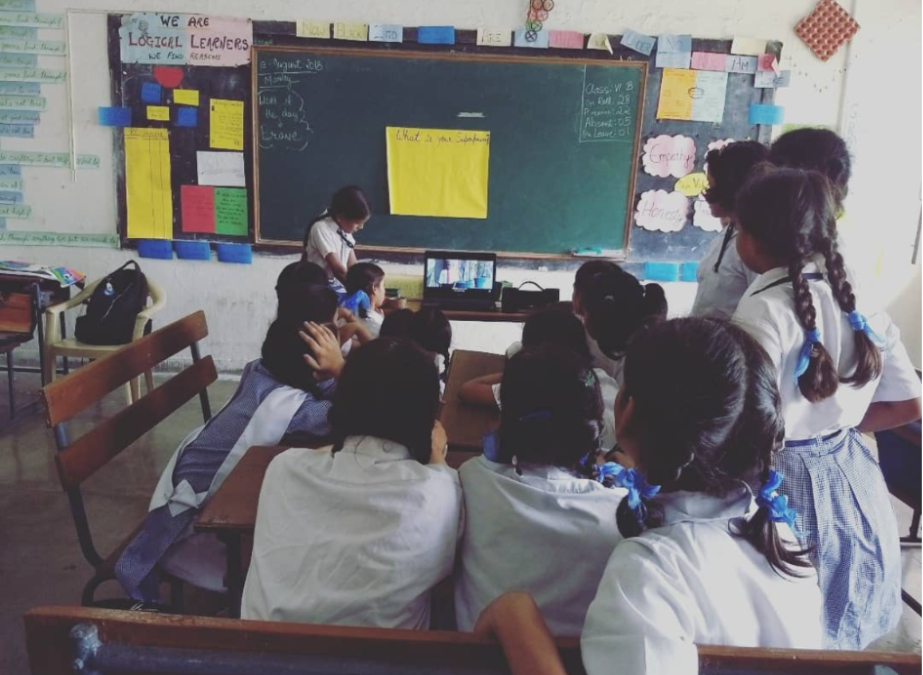
Students engaged in a collaborative experience of reflecting on their superpowers
Both choices, stepping sideways in college and stepping into that classroom, were versions of the same movement. Away from the known and safe and toward what I actually believed in.
I work now in Uttarakhand, a rural hilly state, in the same district, the same block, where my village is. Where my grandparents came from before they migrated to the town in search of stable income and a school for their children. Where my grandmother lived a life in which the question of her own education was never asked.
The line between her struggle and mine
Six months ago, I met Sudesha Devi. She is eighty-six years old. She sat with a fearlessness and a sense of justice that filled the room, and a satisfaction that was quiet but absolute- the satisfaction of someone who fought for something and lived to see it matter. Girls have access to education now, in these hills. She knows she is part of why.
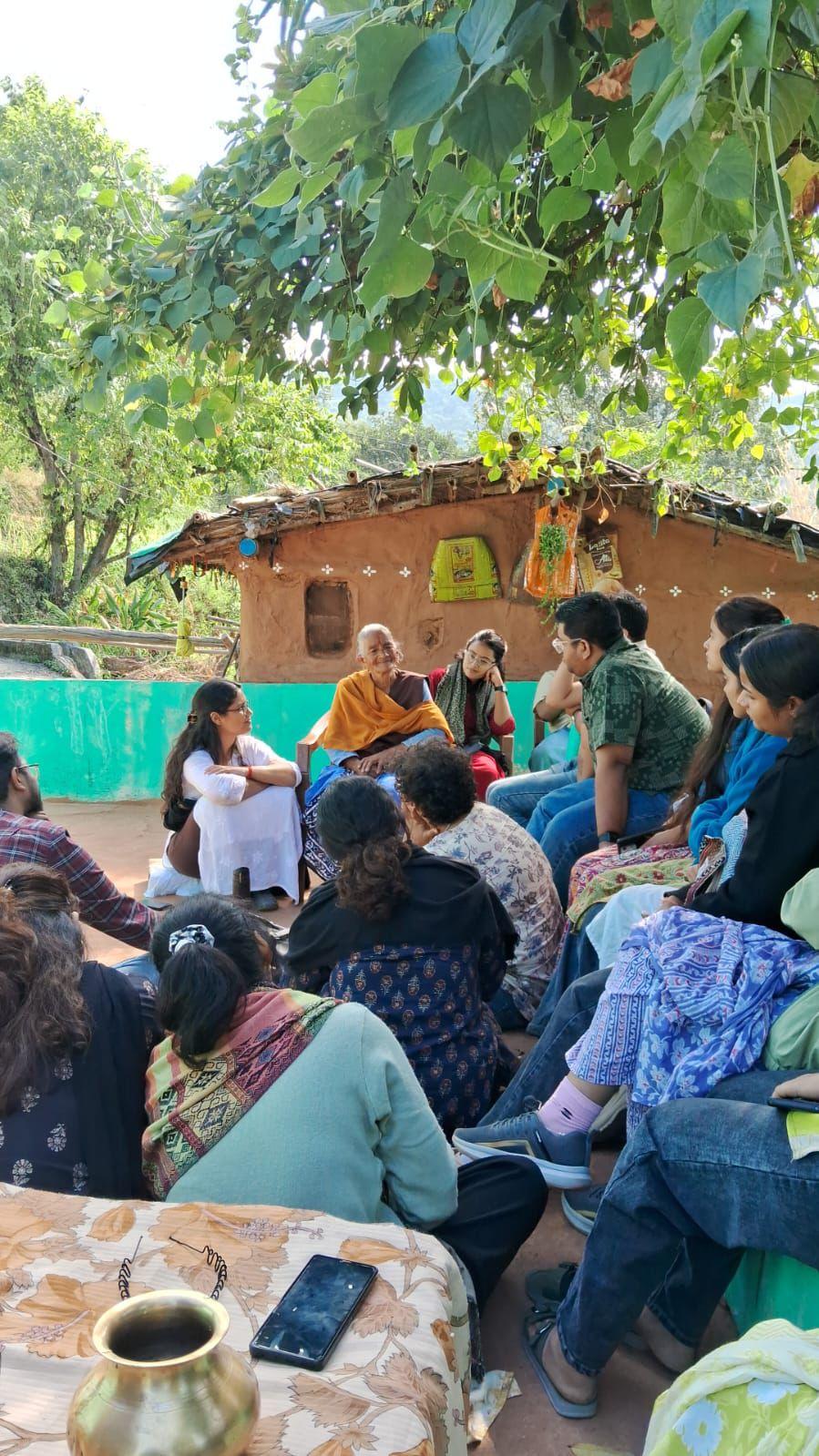
Sitting in a circle with Sudesha Devi
I sat with her and felt something shift in me.
I had spent years working on education in these communities without fully understanding the matriarchal lineage I was part of. My grandmother married at fourteen. My mother went to school because women like Sudesh Devi made it possible. My parents, as teachers, worked hard to ensure each child they taught had a chance at success and dignity. And now I work in the same hills, trying to hold together something that is quietly coming undone.
The line between her struggle and mine is not a straight one. But it is a line.
Sitting with Sudesha Devi, I felt the pride of what had been won. And then, slowly, I began to feel the weight of what was slipping. Because the school she fought for, the one that would reach every girl regardless of what her family could afford, was no longer the school families were choosing.
What is quietly coming undone
There is a shift happening in these hills that does not make headlines.
Families in rural Uttarakhand are slowly, steadily losing faith in the public school. Not because they have stopped caring about their children's futures. It is precisely because they care and that is why they are looking towarda private schools in the nearest town. Towards sending children to live with relatives in the city. Towards a version of education that looks and sounds like urban development- English medium, competitive exams, a pathway out.
My grandparents made that same journey from village to city, in search of something better. I understand the impulse. It is not wrong to want more for your children. But I also know that the choice to leave is only available to some.
And I also know what gets lost in that movement. The languages that don't survive the translation. The knowledge that belongs to a specific landscape doesn't travel well to concrete classrooms. The girls who don't make it as far as the city, who fall through the gap between the public school that is no longer trusted and the private school that was never meant for them.
Sudesh Devi fought so that girls in these hills could go to school and receive quality education.
The system worth believing in
The public system is not struggling because the people within it don't care. My parents are evidence of that. The teachers I work with are evidence of that. They stay in underfunded schools, in villages that migration is slowly emptying, without adequate support, without recognition. The system is under-resourced, under-trusted, and under-imagined.
And yet it is the only system that will reach every child. The child in the village accessible only on foot. The girl whose family cannot afford the fees. The child who has no other option. No private school will go there. No market solution will find it worth the unit cost.
This is the paradox we are living inside: the system that matters most is the one we have collectively stopped believing in.
We made a choice in our work at Simple Education Foundation, not to build something new and separate, but to work within what exists. To partner with the government. To sit alongside teachers, school leaders and functionaries, to ask what they already know and what they need, and to build from there. What emerged was a model that begins in classrooms and moves into systems, built on the kind of trust that takes years to build.
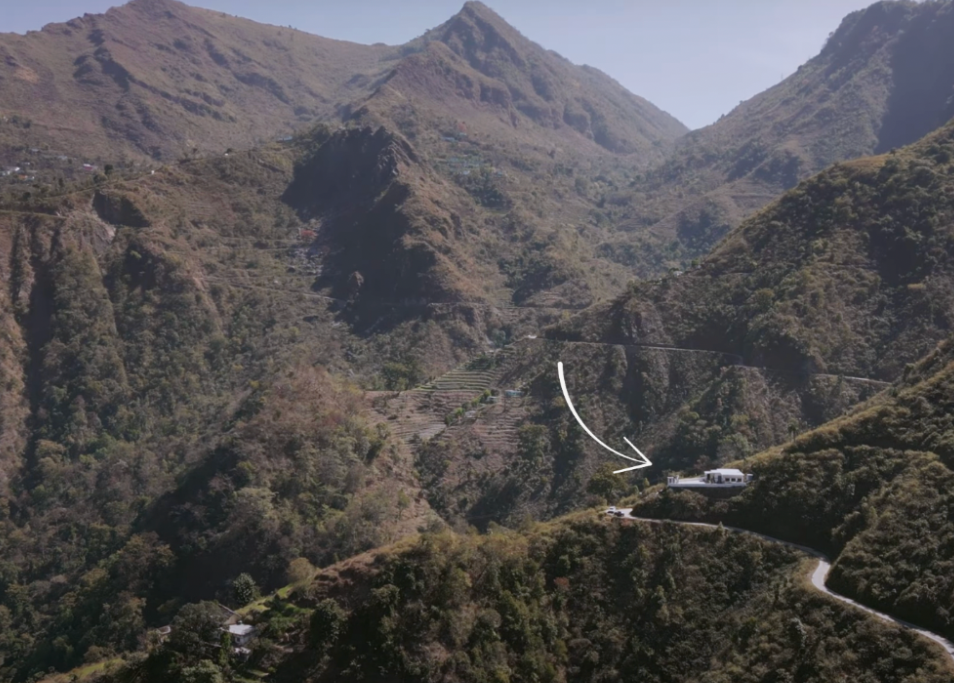
The arrow points to one of the schools in this region Simple Education Foundation works closely with this school as a Partner School
It is not the faster choice. It is not the more visible one. But it is the choice that says: these institutions belong to these communities, and the people inside them are worth investing in.
It is, in some ways, the same choice Sudesh Devi made- to work with and for the community you are rooted in, not around it.
These choices- my grandmother's life, Sudesh Devi's fight, my parents' classrooms, the girl in Grade 4, the schools I work in now- are not separate stories. They are the same story, still being written.
I did not set out to work within a broken system. I set out to work within the only one that would reach every child. The difference matters. And I am asking the same of you.
Not to abandon what you know, but to expand what you are willing to resource and imagine. To invest in depth, not just scale. To treat the block, the cluster, the single school as a worthy unit of change. To fund the slow work of building trust between institutions and communities, between teachers and families, between the state and the people it is meant to serve.
To ask, seriously, what it would mean for a girl in a remote hill village to receive an education that does not ask her to choose between her roots and her future.
My grandmother did not get to ask that question. Sudesh Devi spent her life so that others could. My mother was one of them. I am one of them.
The window for the next generation is not indefinite. Every year that passes is another cohort of children who receive the message, implicitly but unmistakably, that they were not worth the effort.
We are asking you to act as if they are.
Because they are.
The work is alive. The people doing it are extraordinary. And there is room for more heads, hearts and hands. If you want to be part of building public education systems that reach every child, we would love to hear from you. You can be part of what makes it possible- through funding, partnership, or expertise- there is a place for you in this work. Connect with us
Paryma Fellowship
-
Learn more about the Paryama Fellowship →
-
Get to know the Parayma Fellows →
-
Support the Parayma Fellows →
Seed, Root, Bloom, or Harvest?
Take the Quiz!
A short reflective quiz to find your season of changework.
Subscribe to The Changework Journal
Get first access to new offers, free or discounted tickets to events Nora speaks at, exclusive access to funding opportunities we source from our network (not shared anywhere else on our channels), and more!