Changeworker of the Week #39: Ayşe Gizem Taş Translating sustainability into decisions that support life
Jun 12, 2026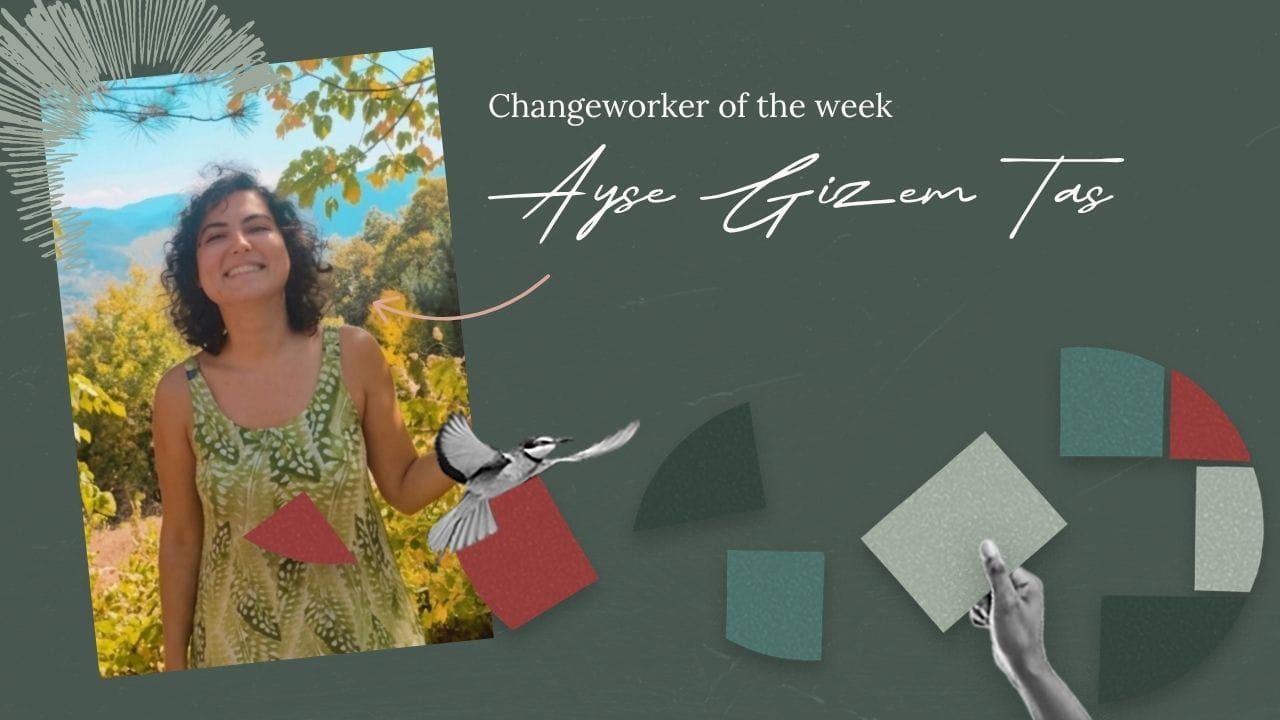
What if sustainability wasn’t about proving we’ve done less damage, but about asking whether our work actively supports life? This question sits at the heart of Ayşe Gizem Taş’s changework.
As an architect, sustainability consultant, and founder of ALGA Consulting, she helps translate sustainability evidence into decisions that shape healthier buildings, stronger communities, and more regenerative futures.
Her work spans green building certification, embodied carbon, life cycle assessment, and regenerative approaches. Yet beneath the technical language lies a deeper inquiry: How can the built environment stop extracting from life and begin actively supporting it?
Through the #MyPieceForChange campaign, we invite people to share their unique contributions to collective transformation. This series exists to honor their stories, amplify their voices, and connect them with a wider community of like-minded peers. Today, we’re honored to introduce our Changeworker of the Week: Ayşe Gizem Taş whom we had the pleasure of interviewing for this special spotlight.
What’s your piece for change?
My piece for change is translation; turning sustainability evidence into the decisions that shape what actually gets built, so that buildings become places of regeneration rather than extraction.
I work with green building certification, embodied carbon, life cycle thinking, and regenerative approaches. But underneath the technical work, I keep returning to one question: how does the built environment stop hollowing the world out and start supporting life?
Buildings are never just buildings. They sit inside soil and water, communities and time. They shape who we get to become inside them. The moment we start reading them as part of living systems instead of isolated objects, the work changes.
What inspired you to begin this work or stay committed to it?
I trained as an architect, and from 2013 I worked as a green building consultant across Türkiye, Europe, and the Middle East, airports, data centres, retail flagships, offices, logistics, federal buildings.
After becoming a mother, I left the field for a while during pandemic. I went back to school, studied child development, and wrote stories for children. That pause wasn't a detour. It was the part of my education the architecture degree didn't include: how environments shape the smallest humans, and how the decisions adults make become the rooms children grow up inside.
When I returned to sustainability consulting, I came back as a different reader of the same work. Since then I've been deepening that lens through permaculture, regenerative leadership, systems thinking, and international collaboration, not as a pivot away from green building consulting, but as the missing ground beneath it.
What keeps me here is what I started seeing more clearly on my way back in: the work is hollowing out. Sustainability is too often treated like PR, or busywork. The conversation begins with "how do we get the certificate" instead of "why do we want it, what decisions should it shape, what should it actually unlock?"
Translating that evidence into real decisions — better materials, healthier spaces, lower-carbon strategies, more inclusive design — is the part I find worth doing. Buildings either deepen disconnection or support regeneration. There is no neutral option.
What’s one hope or vision you hold for the future?
That we remember how to live as part of life.
I hope for a future shaped by communities that hold one another, by creativity that is protected rather than exhausted, and by care taken seriously as a way of organising our lives, our economies, our decisions.
On the work side, I want sustainability to stop being about proving we did "less harm" and start being about whether our work actively supports life. I want a built environment shaped by reciprocity, where the people who design, finance, build, regulate, and inhabit our cities share a language that connects carbon, water, health, equity, and care.
Buildings and cities should give back to the people and ecosystems they depend on.
Less harm is a floor. Reciprocity is the direction.
What support or connection are you currently looking for?
I'm shaping ALGA Consulting; a sustainability practice that brings over a decade of green building consulting (LEED, BREEAM, WELL, LCA, embodied carbon) into conversation with permaculture, systems thinking, and regenerative leadership. The technical work hasn't gone anywhere; the framing has. ALGA exists to turn sustainability evidence into decisions that actually shape what gets built.
The name comes from blue-green algae, or cyanobacteria: organisms that have profoundly shaped Earth’s atmosphere and oxygen cycles, often appearing when systems are out of balance, and reminding us that restoration happens through connection, not control. That same logic runs through the practice: technical work only becomes meaningful when it serves the web of life it sits inside, not the other way around.
Measurement, certification, and education aren't separate services here; they're three ways of asking the same question: what does it take for a building to actually support life?
I'm looking to connect with owners, operators, and investors who suspect their sustainability spend isn't shaping decisions; designers and project teams working on buildings where the certificate isn't the point but the evidence still needs to be sharp; and collaborators, educators, facilitators, and specialists working on the human side of this transition.
I'd also like to find a wider ecosystem of people moving in this direction, whether through project work, knowledge-sharing, or unexpected synergies across contexts.
If you work on bridging evidence and decisions, or if this way of thinking feels close with the work you're trying to do, I'd like to hear from you.
What’s one thing about your field or topic you wish more people knew, considered, or acted on?
I wish we talked more honestly about the human side of this work. The way we treat the people on our teams, the communities our projects touch, and ourselves is part of the work, not a side concern. Burned-out teams cannot create regenerative futures. How we work matters as much as what we produce.
The other thing: sustainability data is not the same as sustainability impact. We already produce a huge amount of it; certifications, LCAs, EPDs, energy models, ESG reports, climate frameworks. Unless that information changes a decision, it stays passive. The performance gap between design intent and real-world outcomes is not a glitch. It's the system working exactly as designed.
The real work is translation: turning technical evidence into something owners, operators, designers, and investors can actually decide on, while the decisions are still open. Not after they're locked in, as documentation.
What practices, tools, or resources have supported you most on your changework journey?
Life cycle thinking, because it makes long-term consequences visible inside short-term decisions.
Permaculture has shaped me more than any single methodology. It taught me feedback loops, edges, diversity, care, and the wisdom of working with systems rather than forcing control over them. I did my PDC at Belentepe Permaculture Farm and it changed how I read a building, a brief, a team.
Systems thinking and regenerative leadership — through With Life Community, Laura Storm's Regenerators cohort, a Fritjof Capra course, and ongoing facilitation work with Climate Fresk. They moved my work past compliance and paperwork, toward relationships, governance, collective learning, and long-term value.
Mindfulness, walking, exercising and writing carry the inner side of this work; the part that notices urgency, overwhelm, and the temptation to carry everything alone.
Reading and exploring widely — literature, psychology, sociology, child development, ecology; to keep the work from flattening into one discipline. Different lenses keep the questions honest.
Can you share a moment or experience that deeply shaped the way you approach change today?
I lost my mother just after I graduated from university. Years later, I lost my father in the first year after my child was born, while I was still learning how to be a mother myself.
For a while, I was standing between endings and beginnings. Soon after, I left sustainability work to be a full-time parent during pandemic. Motherhood became one of my deepest teachers. My son taught me to notice the world differently, the importance of small environments, repeated words, emotional safety, and the quiet conditions that allow a person to grow. He reminded me that change isn't only something we design at scale. It's also something we practise in the everyday spaces where people feel seen, held, and free to become. I also went back to school to study child development, and I started writing children's stories. That period rearranged my sense of time. The future stopped being abstract. Climate, buildings, cities, care, justice… These stopped being topics and became questions about the world my child will inherit, and the lives my parents would not be there to see.
What shaped me most was not loss alone. It was the slow work of grieving, the hours of play with my son, the long walks in nature, the practice of staying in the moment when everything in me wanted to rush past it. Therapy came later, and through it I began to meet my own emotions more honestly. I did not return to sustainability work as someone who had resolved everything. Returning became part of the process. It showed me how I responded to pressure, how I carried responsibility, how easily I confused endurance with strength, and how much our inner patterns shape the outer systems we participate in.
That period taught me that change rarely happens as one dramatic turning point. More often, it happens through cycles; attention, repetition, repair, and the willingness to question what we once believed was fixed. It taught me that thoughts, relationships, and systems all change, and that difficult experiences can teach without becoming who we are. Today, I care deeply about creating environments in buildings, teams, communities, and cities, where people don't only survive, but have room to breathe, relate, repair, and grow.
Sustainability became, for me, a question of relationship: with children, places, materials, time, and the lives that come after us.
What collective shift do you believe is needed for meaningful change to happen and what gives you hope that it’s possible?
A shift from control to relationship.
The built environment has been shaped by a mindset of extraction, speed, optimisation, and short-term return. Meaningful change asks us to slow down enough to see interdependence: between buildings and landscapes, finance and ecology, human wellbeing and planetary boundaries.
What gives me hope is that more people are now asking better questions. Professionals, communities, young people, parents, designers, climate practitioners across sectors, the old definitions of success are losing their grip. The shift is messy, imperfect, and definitely not moving fast enough. But it's real, and it's happening.
How do you take care of your own energy or wellbeing while doing this work?
Honestly, I'm still learning. For a long time I confused caring deeply with carrying too much. I'm slowly learning that regenerative work also asks for regenerative ways of working.
Walking, exercising, writing, time in nature, time with my child, mindfulness, and creative practices help me return to myself. And I try to remember I'm not here to solve everything alone. My role is to contribute my piece with clarity, care, and enough energy to keep going.
Where can people learn more about your work or connect with you?
- LinkedIn: linkedin.com/in/ayse-gizem-tas
- Website: alga.consulting
- Blog: @maviyesilalgae
The Parayma community is rooted in authentic, supportive relationships.
Ayşe’s changework reminds us that sustainability is not simply a technical challenge.
It is a relational one. A question of how we design our buildings, our systems, our communities, and ultimately our lives.
Thank you, Ayşe, for sharing your thoughtful #PieceForChange.
If you are working at the intersection of regeneration, systems change, and care, we invite you to share your story and join the movement.
Seed, Root, Bloom, or Harvest?
Take the Quiz!
A short reflective quiz to find your season of changework.
Subscribe to The Changework Journal
Get first access to new offers, free or discounted tickets to events Nora speaks at, exclusive access to funding opportunities we source from our network (not shared anywhere else on our channels), and more!